
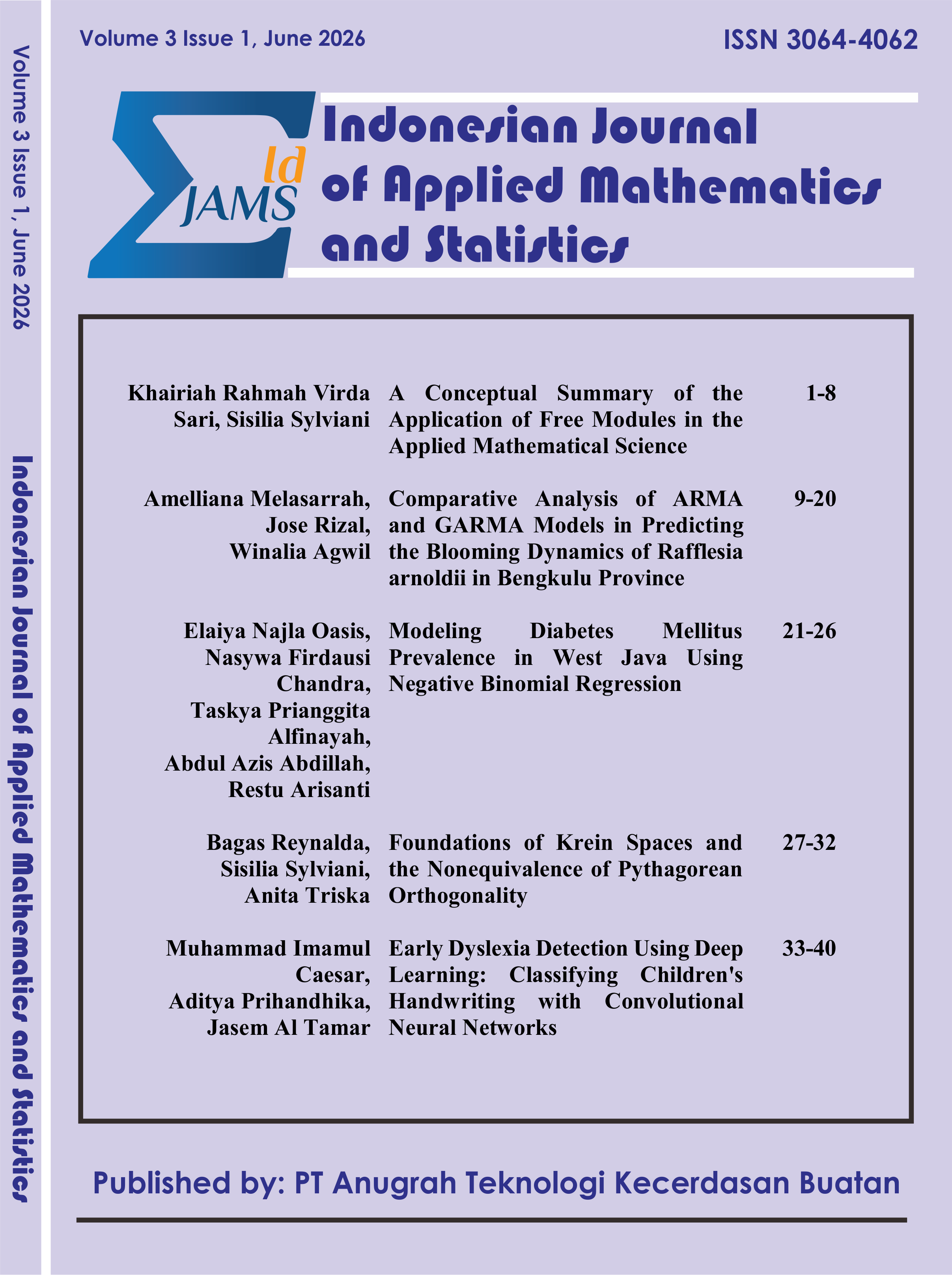
Early Dyslexia Detection Using Deep Learning: Classifying Children's Handwriting with Convolutional Neural Networks
DOI:
https://doi.org/10.71385/idjams.v3i1.34Keywords:
Dyslexia Detection, Handwriting Classification, Deep Learning, Convolutional Neural NetworksAbstract
This study investigates the development of an automated handwriting-based dyslexia classification model using a Convolutional Neural Network (CNN). The dataset comprises scanned handwriting samples from children diagnosed with dyslexia and those without learning difficulties. Prior to model training, the images were resized to a uniform dimension, converted to grayscale, and normalized to standardize pixel intensity values. Data augmentation techniques, including rotation, scaling, and horizontal shifting, were applied to increase data diversity and reduce overfitting. A lightweight CNN architecture was then employed to perform binary classification between dyslexic and non-dyslexic handwriting samples. Experimental results indicate that the proposed model achieved an accuracy of 51%, with a precision of 0.51 and a recall of 0.42, suggesting that its current predictive performance remains limited. These findings highlight the challenges of dyslexia classification using handwriting features alone, particularly when constrained by model simplicity and data resolution. Nevertheless, this study serves as an exploratory step toward automated dyslexia screening and provides insights for future work, where performance may be improved through the use of deeper network architectures, such as ResNet-18, and higher-resolution handwriting representations.
Downloads
Published
How to Cite
Issue
Section
License
Copyright (c) 2026 Indonesian Journal of Applied Mathematics and Statistics

This work is licensed under a Creative Commons Attribution-ShareAlike 4.0 International License.
The copyright of this article is held by the Indonesian Journal of Applied Mathematics and Statistics (IdJAMS). All rights are reserved. No part of this article may be reproduced, distributed, or transmitted in any form or by any means without prior written permission from the IdJAMS Journal, except as permitted under applicable copyright laws.


