
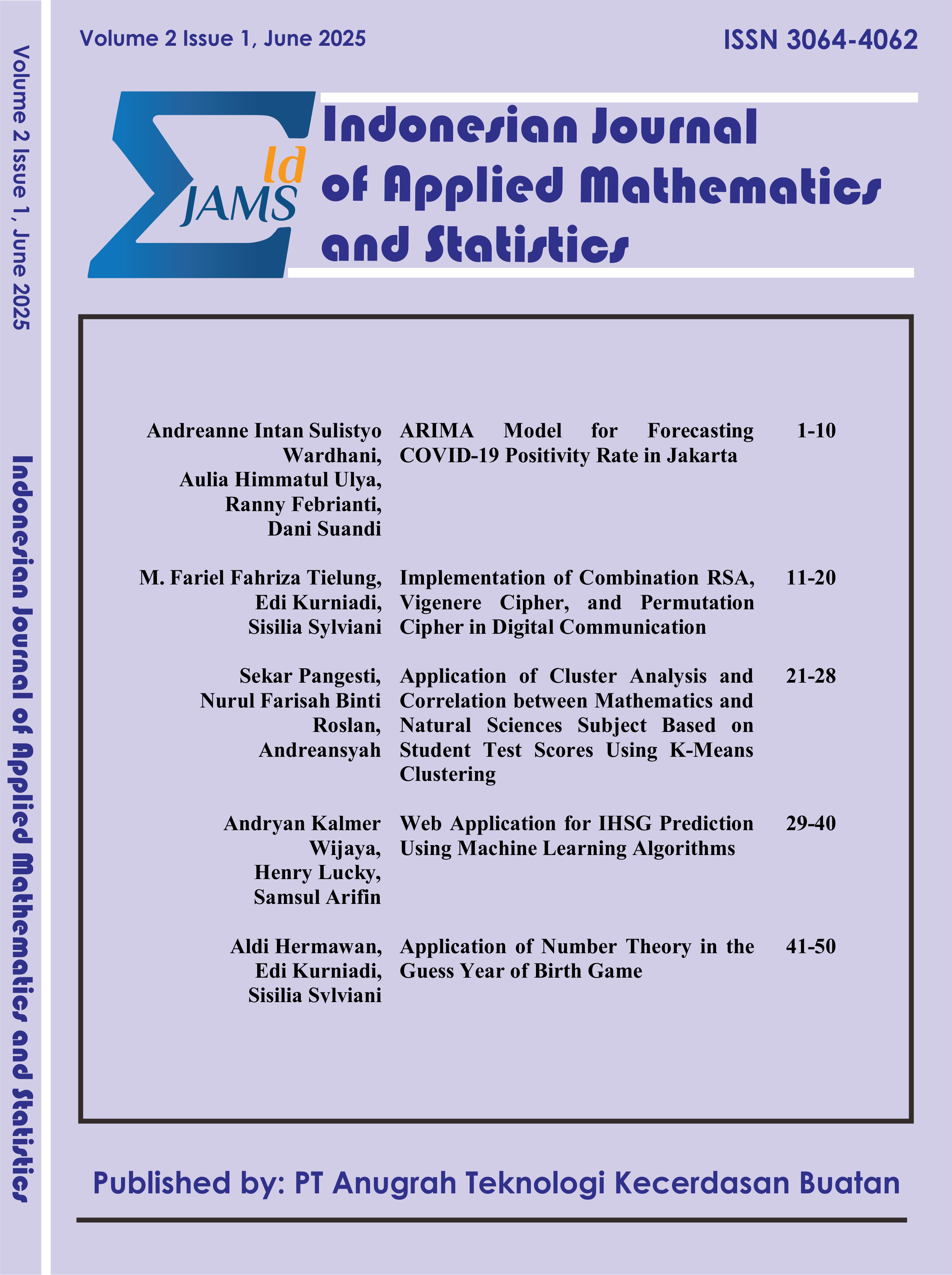
Web Application for IHSG Prediction Using Machine Learning Algorithms
DOI:
https://doi.org/10.71385/idjams.v2i1.21Keywords:
LSTM, Recurrent Neural Network, Price Forecasting, Composite Stock Price Index, Linear RegressionAbstract
This study investigates the effectiveness of the Long Short-Term Memory (LSTM) method in predicting the stock price of the Composite Stock Price Index (CSPI). LSTM, a variant of Recurrent Neural Networks, is designed to overcome challenges such as the vanishing gradient problem and long-term dependencies in time-series data. Given the dynamic and volatile nature of financial markets, accurate stock price prediction is crucial for investors and analysts. The data set used in this study consists of daily CSPI prices from January 2000 to December 2023, which serve as both training and testing data for model development. The LSTM model is trained to forecast the next day’s stock price, and its performance is compared with traditional statistical models, particularly the Autoregressive Integrated Moving Average (ARIMA) model and linear regression. Performance evaluation is based on the Mean Absolute Percentage Error (MAPE), a widely used metric for assessing predictive accuracy. The results indicate that while the ARIMA model achieves a lower MAPE of 0.7%, demonstrating slightly superior accuracy, the LSTM model also performs well, with a MAPE of approximately 1%. These findings suggest that while statistical models like ARIMA remain highly effective for stock price forecasting, deep learning approaches such as LSTM still offer promising predictive capabilities, especially when handling large and complex datasets. The ability of LSTM to capture non-linear patterns and temporal dependencies makes it a viable alternative for financial forecasting, potentially benefiting traders and market analysts seeking data-driven decision-making tools.
Downloads
Published
How to Cite
Issue
Section
License
Copyright (c) 2025 Indonesian Journal of Applied Mathematics and Statistics

This work is licensed under a Creative Commons Attribution-ShareAlike 4.0 International License.
The copyright of this article is held by the Indonesian Journal of Applied Mathematics and Statistics (IdJAMS). All rights are reserved. No part of this article may be reproduced, distributed, or transmitted in any form or by any means without prior written permission from the IdJAMS Journal, except as permitted under applicable copyright laws.


